Rural isolation
The DryRural isolation in The Dry is more than living far from other people. It is the combination of vast distances, unreliable communication, demanding land, and a small-town social world in which scrutiny does not guarantee support. Gretchen Schoner’s separation at Kellerman Farm makes that contradiction personal; Aaron Falk’s reflections set it against the anonymity he values in Melbourne; and the Hadler family’s remote farm shows how country quiet can become a source of unease rather than peace.
Landscape and the promise of country life
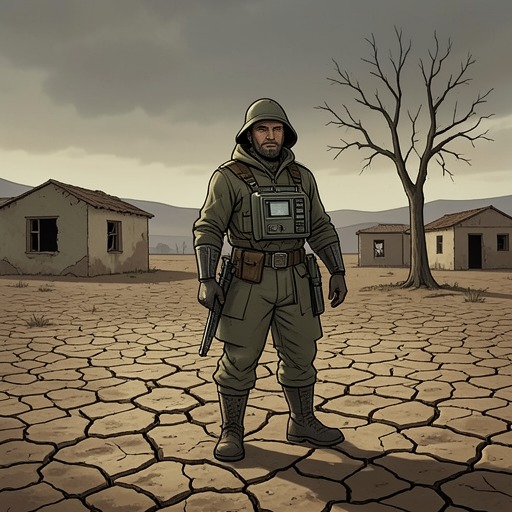
Falk understands why newcomers imagine rural life as wholesome. From a traffic jam or a garden-less apartment, the country seems to promise clean air, neighborly familiarity, homegrown vegetables, and children learning the value of work. Yet the arrival of an empty moving truck leaves newcomers facing a scale they had not anticipated: open land stretches so far that there may be no one between them and the horizon. The space is not only freedom. It can feel crushing, even as though there were enough of it to drown in.
The work of living there further unsettles the ideal. Vegetables do not grow as readily as they did in a city window box; each green shoot has to be coaxed from reluctant soil. Neighbors, occupied with farming on an industrial scale, may have little time or cheer to spare. Without the daily traffic jam, there may also be nowhere much to drive. The country’s quiet, then, is not an uncomplicated escape from city pressure. It can mean few destinations, hard work, and little incidental contact with others.
Distance without dependable connection
Gretchen’s experience gives this landscape a precise human cost. She and her son, Lachie Schoner, live by themselves on the vast Kellerman Farm, which she bought. Even Falk, who generally prefers his own space, remembers the eerie isolation of the Hadler farm and recognizes how quickly hours among fields can make a person crave company. For Gretchen, however, the central problem is not simply the absence of people nearby. She feels cut off: internet access is unreliable, phone coverage is patchy, and she does not have a large circle of people trying to reach her.
That disconnection becomes painfully visible after Luke Hadler’s death. Gretchen does not learn what has happened until the next morning, despite her history with Luke and the Hadler family. No one, including Gerry Hadler or Barb Hadler, calls her. Her ordinary evening—collecting Lachie from school, eating dinner, putting him to bed, and watching a DVD—becomes the last normal one she wishes she could recover. At the school gates the following morning, she discovers that others already know. She drives toward the Hadler farm but cannot get close because the road is blocked and police are there; by then, the news has spread publicly. Physical distance and failed communication have made her not merely late to the event, but painfully aware that she was not treated as a priority.
Small-town visibility and urban anonymity
Falk’s comparison with Melbourne complicates any simple equation between rural life and loneliness. He has chosen a city life he considers happy: he can walk among crowds without being recognized, and his work taxes his brain rather than his back. His flat may be quiet and empty when he returns, but his neighbors do not judge him, harass him, spread rumors about his family, or leave animal carcasses on his doorstep. The city offers less intimacy, but also a form of protection through anonymity.
In Kiewarra, people may know one another’s business while still failing to offer practical care. Gretchen’s exclusion after Luke’s death shows the distance between being part of a small community and being remembered when it matters. Falk’s own preference for collecting acquaintances rather than close friends is shaped by a more intimate fear: he has seen what happens when someone close to home floats dead in a river. His city anonymity is not presented as a cure for grief or a substitute for friendship; it is a way to avoid the scrutiny and exposure that made his family vulnerable to judgment and harassment.
Isolation, drought, and the novel’s emotional landscape
The country’s physical conditions also sharpen the stakes of isolation. Falk recalls that a livelihood on the land can hang by a thread on the whim of weather. Under blank skies, people may be driven toward fear and despair so severe that a gun can seem like the wrong end of one. The novel does not make remoteness the sole explanation for violence, but places it beside drought, economic dependence on the land, and a community whose burdens can be endured without meaningful relief. In this setting, the absence of rain is not scenery: it bears directly on work, security, and people’s sense of what choices remain.
Falk’s imagined alternative life on the land briefly suggests warmth, noise, laughter, and someone waiting at home. He wonders whether that imagined person could have been Ellie Deacon, then recognizes the vision as fantasy: too many chances have been lost for it to become real. The contrast returns the question of rural belonging to an individual scale. A home and a familiar landscape do not themselves promise companionship or rescue.
The same tension appears in Falk’s memory of the children’s paintings at the school. Many show sad faces and brown landscapes, while Billy Hadler’s pictures are brighter: airplanes with smiling passengers and variations on cars. Falk thinks Billy had not been sad like some of the other children, then confronts the grim contradiction that Billy is dead and would have been terrified at the end. The contrast cannot establish what any child’s picture proves about life at home. Instead, it makes the rural setting’s emotional weight difficult to dismiss: the land and its quiet are inhabited by children, families, and fears that a cheerful image cannot settle. Across these scenes, isolation is both geographical fact and social condition—sometimes a chosen distance from judgment, sometimes an imposed disconnection, and sometimes the silence in which distress goes unseen.